
What is data lineage?
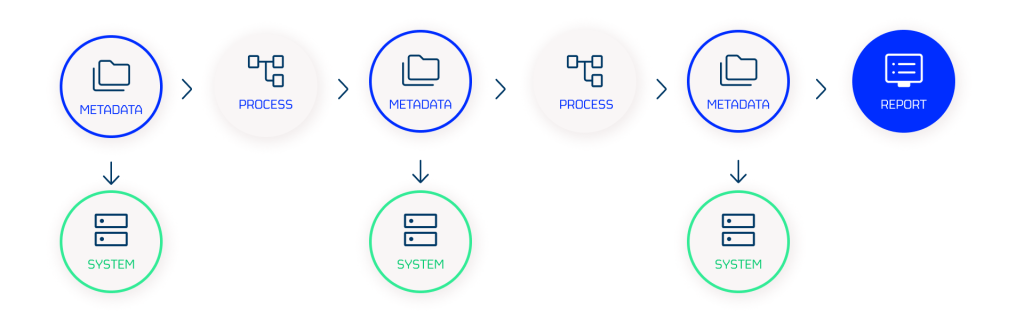
Data lineage is the process of tracking data through its lifecycle, from creation to end destination. It provides a record of where data originates, how it moves through your organisation and how it gets transformed along the way.
Think of it as a roadmap, showing the route your data has taken through your organisation and all the stops it has made along the way.
Why is data lineage important?
By being able to trace the lineage of a piece of data, organisations can improve the quality of their data, enhance compliance and make better business decisions.
Data quality: with clear data lineage, firms can more easily spot inconsistencies and errors within their data. This empowers them to take corrective action and prevent further issues moving forward. It can also aid in disaster recovery and backup should anything go particularly awry.
Better decision-making: by maintaining the accuracy and consistency of their data across its lifetime, organisations can ensure the quality of their data. This has numerous benefits, including the ability to make better data-driven business decisions and reduce the risk of costly errors.
Improved security: data lineage is essential in keeping your data secure as it helps to identify any potential breaches or vulnerabilities across your organisation’s data pipeline. This, in turn, helps maintain trust in your data and safeguards your company’s reputation.
Compliance and transparency: transparency is another key benefit of tracking data lineage. By providing a complete view of a piece of data across its lifetime, organisations can ensure they are complying with both internal data governance policies and external regulation.
What are the challenges?
Data ecosystems within organisations can be complex. They can evolve rapidly as teams introduce new pipelines and make updates or changes. This dynamic backdrop presents challenges for tracking data lineage, especially if an organisation is attempting to do it manually.
The sheer volume of data today, and its rapid generation and diverse formats, can mean firms require sophisticated tools and methodologies to effectively keep track of data as it moves through their organisation. These solutions then need to keep pace with changing regulations and evolving business requirements. This can end up a time-consuming and resource-intensive process for businesses.
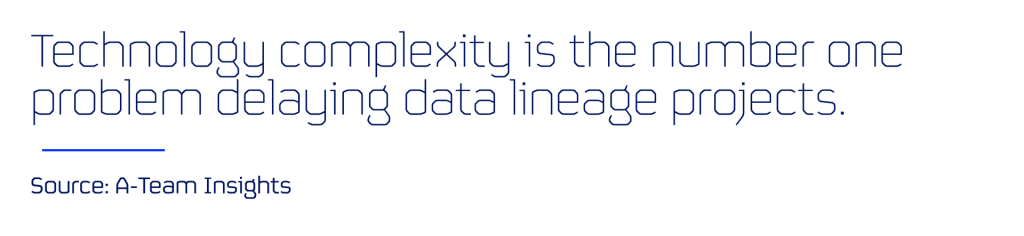
Research conducted by A-Team Insights found the top three challenges delaying data lineage projects were concerns around technological complexity, a poor understanding of data lineage within their business, and a lack of management buy-in or a lack of budget and resources.
Five best practices for implementing data lineage
As we’ve discussed, the increasing complexity of businesses’ data ecosystems in the last couple of decades has made tracking data lineage more and more difficult. But, by adhering to a few simple principles, your firm can drive a successful implementation:
- Standardise naming conventions: enforce consistent naming conventions to reduce confusion and simplify tracking.
- Document data sources: maintain detailed documentation of all data sources within your organisation.
- Define clear ownership: establish ownership and stewardship of data assets to ensure accountability for its quality.
- Continually audit and update: schedule periodic audits to identify any gaps or inconsistencies.
- Automate: automate your data lineage capture so you can avoid the risk of human error and speed up your processes.
How Raw Knowledge can help
At Raw Knowledge, we simplify the complexity of tracking your data’s journey with our automated data lineage capabilities. Our Managed Smart Data platform provides clear visibility into how and why your data has changed over time – along with easy access to historical dataset versions – so you can stay focused on delivering exceptional service to your clients.
Spend less time chasing data and more time delivering exceptional outcomes for your clients with smarter data management.