

Excess Reportable Income (ERI) is one of the most commonly misunderstood and frequently misreported areas of UK investment taxation.
This guide explains what Excess Reportable Income is, who it applies to, when and how it should be reported, and why accurate ERI data matters to both investors and their financial advisers. It is designed for UK investors, financial advisers, wealth managers and portfolio administrators who are looking for clarity on offshore fund reporting and want to better understand why it remains such a complicated area of UK tax.
Topics covered in this guide:
- What is ERI?
- How are Offshore Funds taxed in the UK?
- What’s the difference between reporting and non-reporting offshore funds?
- Who is responsible for reporting ERI?
- Who does ERI affect?
- Where can you find accurate ERI data?
- Where do you put ERI on a tax return?
- When should ERI be reported?
- Do I need to report ERI if my fund didn’t pay out?
- Is ERI relevant to non-UK taxpayers?
- Does ERI apply to ETFs?
- Does ERI apply to Managed Portfolio Services?
- FAQs
What is Excess Reportable Income?
Excess reportable income (ERI) is the profit earned by an offshore reporting fund that isn’t distributed to investors, whether as dividends or interest. UK tax rules treat this undistributed income as if it had been paid to the investor.
As a result, UK investors may have to:
- Declare ERI on their tax return
- Pay income tax on the ERI
ERI only needs to be declared where the investment is held outside of a tax-efficient wrapper, such as an ISA or SIPP.
How are Offshore Funds Taxed in the UK?
The way ERI is taxed depends on whether an offshore fund has reporting status with HMRC.
Offshore funds can apply for ‘reporting’ status with HMRC if they agree to comply with several rules, like the requirement to have an independent audit and annually report a calculation of reportable income.
These requirements bring the offshore fund more closely in line with the rules for UK funds, meaning they can have a similar tax treatment.
The Tax Treatment of Offshore Non-Reporting Funds
When an investor sells a position in a non-reporting fund, HMRC will assume all income within the investment has not been taxed and will charge the profit on the sale at the investor’s marginal income tax rate.
As a result, an investor in a non-reporting fund could pay income tax on their realised gain at rates of up to 45%.
The Tax Treatment of Offshore Reporting Funds
Reporting funds are required to publish an excess reportable income rate for all the income recorded in the fund, confirming the amount that would have been paid if the fund had paid out. This undistributed income is calculated each year, and investors must pay income tax as if they had received it.
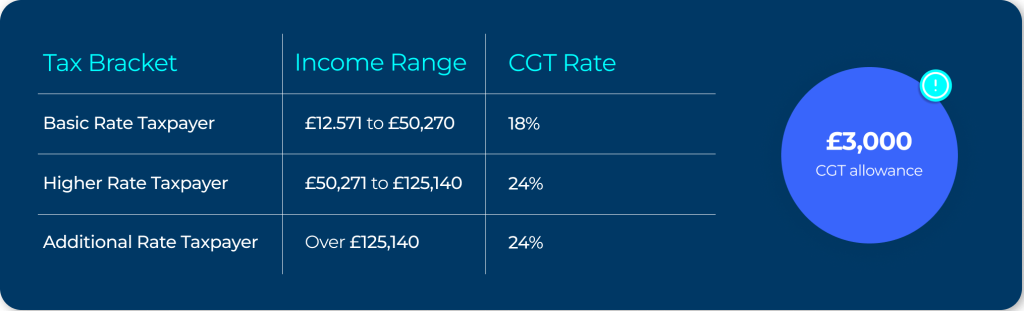
When an investor sells their fund units, they get extra base cost because they’ve already paid tax on the benefit of keeping the income within the fund. As a result, any gains are taxed as capital gains rather than income.
Reporting vs Non-Reporting Offshore Funds – What’s the Difference?
An offshore fund that has been approved by HMRC as a reporting fund is required report details of their income to HMRC and their UK investors, regardless of whether this income has been distributed or not.
Non-reporting funds have no obligation to report their income to HMRC but is likely to be obliged by local law or its constitution to provide information to investors in respect of the income arising in the fund. It is the responsibility of the investor to obtain and record this information.
Apply for reporting status with HMRC is entirely optional and can only be done by the fund manager or investment adviser.
How Reporting Funds Publish ERI Information to Investors
Reporting funds should publish the ERI rate for all the income recorded in the fund annually. However, investment funds aren’t required to provide ERI data in a standardised way, and it isn’t always accessible or up to date on investment funds’ websites.
Many financial advisers will rely on their platform providers for the ERI information and relay this to their clients, but platform data is only likely to be as good as the data given to them by offshore fund managers and this can be challenging to interpret and reconcile.
Who is Responsible for Excess Reportable Income Reporting?
The onus is ultimately on the end-investor to provide the right information on their tax return if they invest in offshore funds. If ERI information is missing or recorded incorrectly on a tax return, an investor can be fined up to 200% of the tax due, plus interest and potential late payment penalties.
Consumer Duty Considerations
At Raw Knowledge, we believe that we should all be committed to providing the right details to investors and that failing to do so could be seen as falling short of Consumer Duty responsibilities.
Research conducted by our sister company, Financial Software Ltd, in collaboration with the Lang Cat, found that 93% of investment platforms offer offshore funds, yet only 52% offer ERI reporting as part of their tax packs to investors.
By ensuring that your firm has accurate, up-to-date offshore fund information, you can help your clients avoid hefty penalties and protect against reputational risks for your business.

Who Does Excess Reportable Income Affect?
Excess reportable income doesn’t affect every single investor – only those with interests in offshore funds outside of an ISA or a SIPP. However, with the popularity of managed portfolio services (MPS) on the rise, UK investors are increasingly likely to have a holding in an offshore fund.
According to research by the Lang Cat, nearly three quarters of the MPS ranges on their Analyser software contain offshore funds. This means there’s a high likelihood that an investor holding one of these investments would need to report ERI information to HMRC.
Why Accurate Excess Reportable Income Reporting Matters
If ERI information is missing or recorded incorrectly on a tax return, an investor can be fined up to 200% of the tax due, plus interest and potential late payment penalties.
HMRC is also clamping down on unreported offshore interests and investment. According to a report by the Financial Times, HMRC sent nearly 24,000 nudge letters in the 2022/23 tax year, up 31% on the previous year, as part of their effort to crack down on tax avoidance.
Where Can You Find Accurate ERI Data?
Unfortunately, finding accurate and up-to-date ERI information often isn’t easy for investors or their wealth managers.
Funds aren’t required to provide ERI data in a standardised way or ensure that it is easily accessible. As a result, sourcing ERI information can be a frustrating and laborious process, even for an experienced wealth management team.
How Specialist Financial Data Providers Can Help
At Raw Knowledge, we do the heavy lifting of sourcing hard-to-find offshore funds data to make ERI reporting easier for wealth managers, financial advisers and their clients.
We provide firms with a full data set for tax reporting, including fields rarely provided on a fund manager’s original documentation such as equalisation rates and the identification of asset breakdowns.
All our data is verified, structured and traceable, with an internal validation process at each stage, so you can have complete confidence that your reporting will be accurate. In the rare cases we don’t have full coverage of your targeted fund universe, our dedicated team are ready to dig deeper and conduct primary research to source the information you’re looking for.

Where to Put Excess Reportable Income on Tax Return
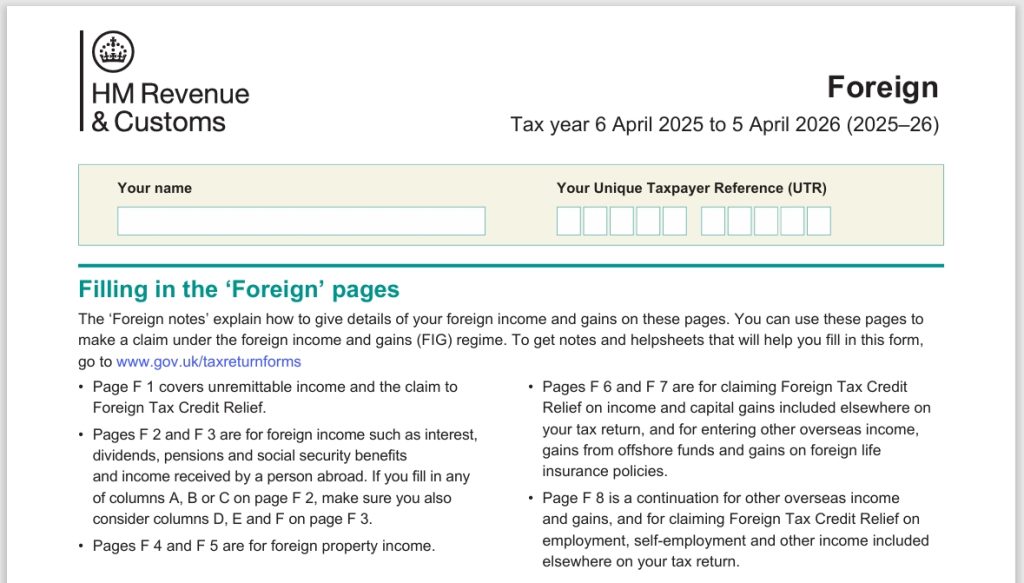
If you’re a UK taxpayer, ERI will need to be detailed on your annual Self Assessment. Income from an offshore fund, including Excess Reportable Income, should be returned in the Foreign Pages (SA106) tax return.
When Should Excess Reportable Income be Reported?
UK investors are subject to tax on ERI if they hold the investment on the last day of the fund’s reporting period. Generally, a fund’s reporting period corresponds with its accounting period, which can be found on its financial statements, but every fund is different so it’s important to check.
ERI is deemed to have been distributed to investors six months after the end of the fund’s reporting period. This ‘deemed disposal’ date is when ERI is treated as being earned for UK tax purposes.
So, if the end of a fund’s reporting period was 31 December 2024. An investor with a holding in the fund would receive an ERI distribution on 30 June 2025 and would therefore record this in their 2025/26 tax return.
What Happens If You Sell Around the Reporting Period End-Date?
The key thing to understand here is that an investor’s ERI obligation is calculated by reference to their holding at the end of the day, not at the start of the day.
This means that an investor would not necessarily be obliged to report ERI if they had sold all their shares in a fund on the last day of the fund’s reporting period. Likewise, an investor would be obliged to report ERI for a fund’s full period even if they had only acquired their holding on the last day of the reporting period.
What If You Sell Then Buy Back Around the Reporting Period End-Date?
If you sold shares but then bought them back within a 30-day period around the reporting period end-date, you will need to calculate ERI as if you continued to hold the shares at the reporting period end-date.
This is because the capital gains tax (CGT) 30-day rule states that units bought within 30 days after units in the same fund were sold are treated as if they were the same units.
So, if on 29 December an investor were to sell units in a fund whose period ends 31 December and then buy units in the fund again on 5 January, their ERI would be calculated as if they had never sold those reacquired units.
Do I Need to Report ERI If My Fund Didn’t Pay Out Any Income?
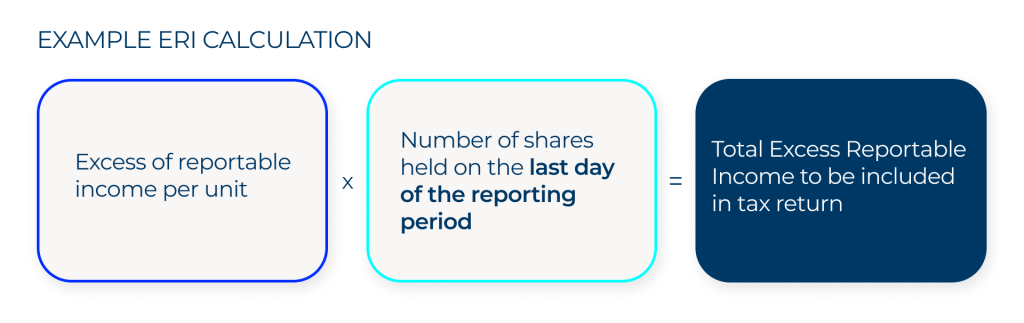
If there is a non-zero ERI rate, then an investor will have to pay ERI. They can work out the amount they owe by multiplying the fund’s ERI figure by the number of shares they held at the end of the last day of the fund’s reporting period.
Even if a fund has paid cash out to investors, if it publishes a document saying there is ERI on top of that then a UK investor will have to report both the cash paid and the ERI on their tax return.
It’s also important to remember that what one jurisdiction calls income and expenses is not necessarily the same thing as under the UK reporting fund regime.
This means that it is possible to see an incredibly low ERI rate for a fund because, according to its governing country’s law, it has paid all its income but, according to UK law, it hasn’t. As a result, an investor could be left with an ERI rate of 0.00001 per share which, though small, would still need to be paid and reported on a UK tax return.
Is ERI Relevant to Non-UK Taxpayers?
ERI is specific to UK tax regulation, therefore if a taxpayer is resident abroad and never lives in the UK, they do not need to worry about ERI.
Does Excess Reportable Income Apply to Managed Portfolio Services?
Offshore funds are surprisingly common within Managed Portfolio Services (MPS). Research from the lang cat shows that, of the 119 MPS ranges they have on their Analyser software, 72% contained offshore funds. This means that there is a significant chance that an MPS investor would need to report ERI to HMRC.
Finding ERI information isn’t easy, however. The data is difficult to find, interpret and validate as funds aren’t required to ensure ERI data is easily accessible and presented in a standardised way.

Does Excess Reportable Income Apply to ETFs?
If your investment is outside of a tax-efficient wrapper like an ISA or a SIPP, you will have to pay tax on the profit you make from selling your ETF. However, the type of tax you must pay will depend on where your ETF is domiciled.
The Tax Treatment of UK-Domiciled ETFs
UK-domiciled ETFs are those that are registered and managed within the UK. These funds are regulated by the UK Financial Conduct Authority (FCA) and are subject to UK tax laws. As a result, if your ETF is domiciled in the UK, the tax you pay will most likely be capital gains tax (CGT) on any profit on the sale of the ETF.
Things can get trickier, however, if the ETF is domiciled outside of the UK.
The Tax Treatment of Non-UK-Domiciled ETFs
If your ETF is not domiciled in the UK, then the tax you pay will depend on whether it has ‘reporting status’ with HMRC.
When an investor sells a position in a non-reporting fund, HMRC will assume all income within the investment has not been taxed and will charge the profit on the sale at the investor’s marginal income tax rate. This means an investor could pay up to 45% on any gains they make.
In contrast, when an investor sells a position in a reporting fund, they get extra base cost because they’ve already paid tax on the benefit of keeping the income within the fund. As a result, any gains are taxed as capital gains rather than income.
FAQ
What is Excess Reportable Income (ERI)?
ERI is the profit earned by an offshore fund that isn’t distributed to investors. Even though it isn’t paid out, UK tax rules treat it as if you have received it, meaning it is taxable.
Do I have to pay tax on ERI, even if I didn't receive any income?
Yes. If your fund reports ERI, you must declare it on your tax return and pay tax on it.
Who needs to report ERI?
UK taxpayers who hold offshore funds outside of tax-efficient wrappers (such as ISAs or SIPPs) are required to report ERI.
Where do I report ERI on my tax return?
ERI should be reported on the Foreign Pages (SA106) of your Self Assessment tax return.
How do I calculate how much ERI I owe?
Multiply your fund’s ERI rate by the number of units you held at the end of its reporting period.
What's the difference between reporting and non-reporting funds?
- Reporting funds: gains on disposal will be taxed as capital
- Non-reporting funds: gains on disposal will be taxed as income
What happens if I don't report ERI correctly?
Incorrect or missing ERI can lead to penalties of up to 200% of the tax due, plus interest and potential late payment penalties.
Where can I find ERI data for my investments?
ERI data is typically published by fund managers annually, but it may not be easy to find or standardised. As a result, many investors and their wealth managers/financial advisers will rely on specialist third-party providers.