
AI has an understanding problem
AI is quickly moving up the agenda for wealth management firms. According to the 2026 MSCI Wealth Trends Report, 95% of wealth managers are planning to increase investment in AI over the next three years. Yet, according to separate research by Gartner, 60% of AI projects are forecast to be abandoned by the end of 2026 due to a lack of AI-ready data.
At Raw Knowledge, we see many AI initiatives running into the same obstacle: AI models can only be as good as the information they can access and understand.
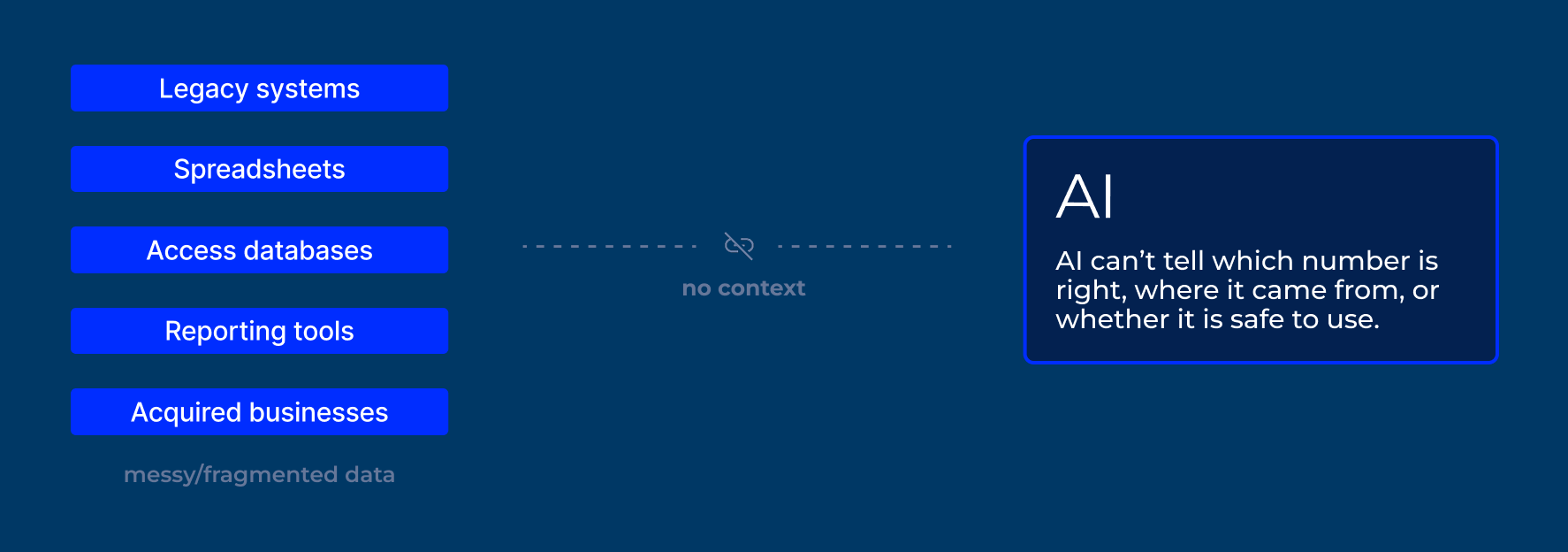
Most financial services firms possess vast amounts of data and have invested heavily in data warehouses, reporting platforms and data governance programmes. But, despite this investment, their underlying data often remains messy and fragmented — siloed across different systems, departments and business processes.
This fragmented environment means while an AI model can access a full range of business data, it can’t understand how those pieces of data relate to one another or what they mean within the firm’s wider context.
Why wealth and asset managers are uniquely exposed
Our industry relies on complex relationships between clients, portfolios, accounts and securities. Each of these data points will exists across multiple systems and often carry different meanings depending on the business context.
Consider the seemingly straightforward request: “show me all clients affected by a particular corporate action.”
To answer accurately, an AI will need to understand:
- Which clients own affected securities
- How those securities are represented across different systems
- Which portfolios contain them
- Any associated tax events
- Any regulatory obligations
All that data may exist. All that data may be accessible. But unless the relationships between those data points are clearly defined, AI has no reliable way of understanding that data fully.
This is problematic in highly regulated industries such as wealth management where businesses need outputs they can trust, explain and defend if they want to stay on the right side of clients and regulators. To achieve that, AI models require more than just access to lots of data. What they need is an understanding of what that data means in specific contexts and how it fits into the wider business.
That’s where a Business Context Layer comes in.
What is a Business Context Layer?
Technically known as an ontology layer, a Business Context Layer provides the definitions, relationships and rules that allows AI to understand how information fits together within your organisation. Think of it like a spider diagram where each bubble is a real-world entity – like a client or a department – and where each line shows the relationship between those things.
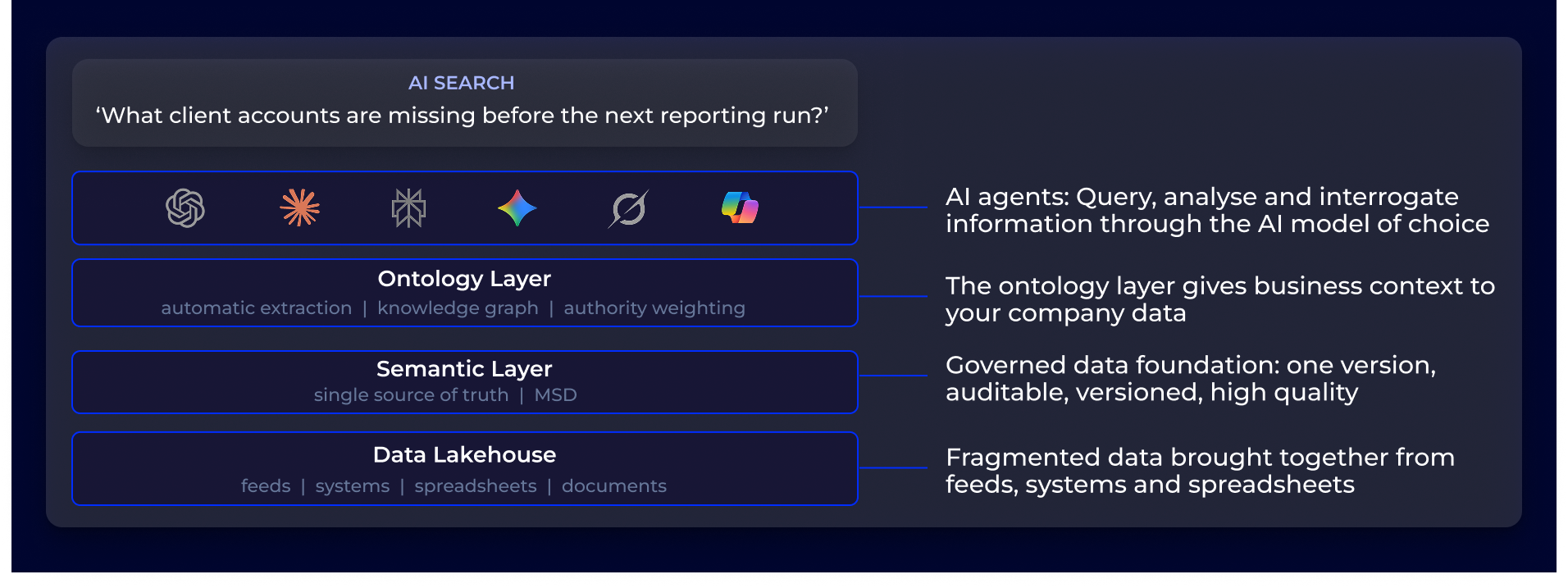
While the concept can sound complex, a Business Context Layer is made up of several practical components that help AI understand business information. Here’s how we’ve developed a Business Context Layer for our own Managed Smart Data Platform:
Natural language data descriptions: The platform automatically analyses underlying data structures and creates human-readable descriptions of what information exists within databases and tables. Rather than seeing a column named “TXN_TYP_CD,” AI can understand that the field contains transaction types relating to client investments and how that information should be interpreted.
Knowledge graph: Information is organised into a connected knowledge graph that maps relationships between business entities. It understands that clients own portfolios, portfolios contain securities, advisers manage clients and accounts sit within wider organisational structures. This provides the context AI needs to reason across multiple systems rather than viewing data points in isolation.
Authority weighting: The Business Context Layer applies a permission-aware authority model to determine which sources are most trustworthy and relevant. Similar to how search engines like Google rank information, the Business Context Layer uses authority signals — like author credibility, usage frequency and data freshness — to prioritise information and understand which sources are the most trustworthy.

What happens when AI understands your business
By capturing the meaning behind data rather than simply providing access to it, a Business Context Layer gives AI the context it needs to operate effectively within a business environment. The benefits can be seen across three key areas: accuracy, explainability and operational resilience.
Improved Accuracy: Without context, AI relies heavily on patterns and probabilities within data. With context, AI can interpret data based on defined business concepts, relationships and rules rather than simply recognising patterns. This makes it far less likely to produce inaccurate or misleading outputs. In fact, studies have shown that combining large language models with structured knowledge graphs can significantly reduce AI hallucinations and improve the reliability of AI-generated responses.
Better Explainability: Accuracy is only one part of the equation. In regulated environments, firms must also be able to understand and justify how conclusions have been reached.
A Business Context Layer helps make AI outputs explainable because business concepts, relationships and definitions are explicitly captured. Rather than receiving a recommendation from a black box, firms can trace insights back to the underlying data, understand the logic behind the result and demonstrate how conclusions were reached. This transparency is particularly important for governance, compliance and building confidence in AI-driven decision-making.
Lower Operational Risk: Many operational issues arise not because organisations lack data, but because information is interpreted differently across systems, teams and processes. A Business Context Layer creates a shared understanding of business concepts, definitions and relationships across the organisation. By providing a common framework for understanding data, this reduces the risk of inconsistent reporting, conflicting interpretations and decisions based on incomplete information.
From fragmented data to single source of AI-ready truth
At Raw Knowledge, we’ve enhanced our Managed Smart Data Platform by developing a Business Context Layer on top of our data lakehouse architecture.
Information is automatically extracted, verified and unified from disparate systems, reports and documents by our platform. It then builds a richer understanding of that information with our Business Context Layer by mapping relationships between business entities through a knowledge graph, and identifying the most authoritative sources through permission-aware authority weighting.
This creates a shared understanding of what that data means, how different information relates to one another, and which sources can be trusted. As a result, AI models can work with business context rather than raw data, enabling more accurate insights, more explainable outcomes and greater confidence in the answers they produce.
Ontology in Action: Raw Knowledge’s ERI Use Case
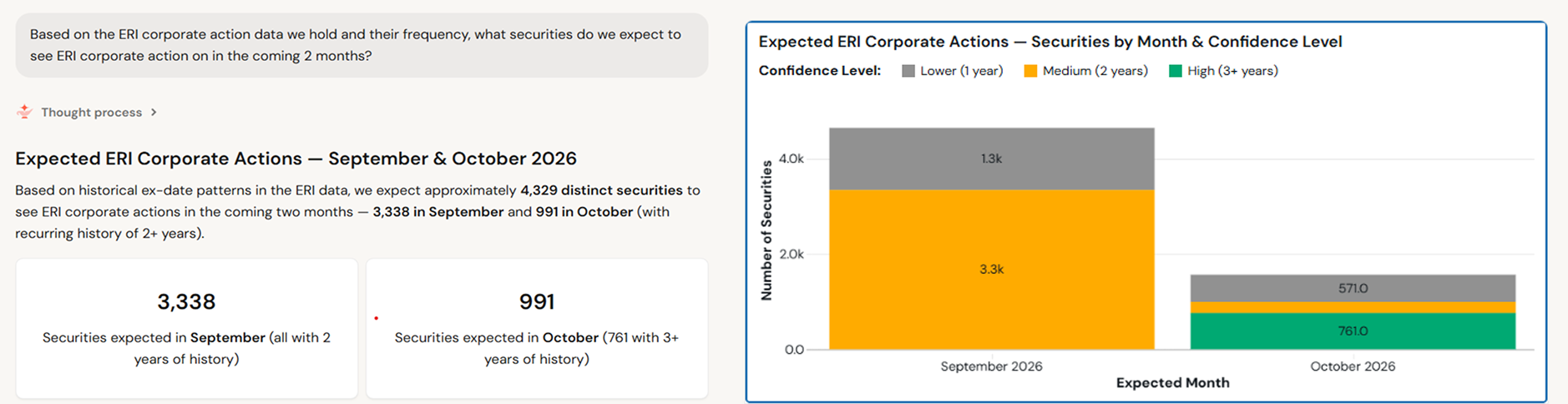
Excess Reportable Income (ERI) is a complex area of UK tax, requiring detailed specialist financial data to accurately report an investor’s tax position. Establishing when a client becomes liable for ERI involves a challenging interplay of different reporting periods and payment dates which can often straddle two tax years.
Prior to embedding a Business Context Layer into the Managed Smart Data Platform, understanding these relationships required specialist knowledge and significant manual effort from the Raw Knowledge team. Once Raw Knowledge captured this expertise within its Business Context Layer, however, it enabled its AI agents to reason about the information in the same way a Raw Knowledge subject matter expert would.
Rather than simply looking at dates in isolation, AI agents could now understand their significance within a wider tax context and identify securities that became liable for ERI in one tax year but were paid in the next. The result was a faster, more consistent process that reduced manual effort and improved accuracy across Raw Knowledge’s ERI data provision.
The value of a Business Context Layer extends far beyond this narrow use case, however. The same approach can be applied to corporate actions, client suitability, portfolio management, regulatory reporting and countless other business scenarios.
AI belongs to firms with trusted data foundations
Ontology represents a fundamental evolution in how firms think about their data landscape. For years, the challenge was collecting, storing and governing data. Today, as firms look to deploy AI at scale, the challenge is increasingly one of understanding. AI can only be as effective as the information and context it receives. Without a clear understanding of business concepts, relationships and rules, even the most sophisticated AI models will struggle to produce reliable outcomes.
By creating a shared understanding of organisational knowledge, ontology — or a Business Context Layer, in our case — provides the foundation for more accurate, explainable and trustworthy AI. It transforms fragmented data into connected business intelligence, allowing AI models to move beyond simply accessing data to truly understanding it.
The organisations that succeed in the next phase of AI adoption will not necessarily be those with the most data. Instead, they will be those that can give AI the context needed to use that data effectively.